
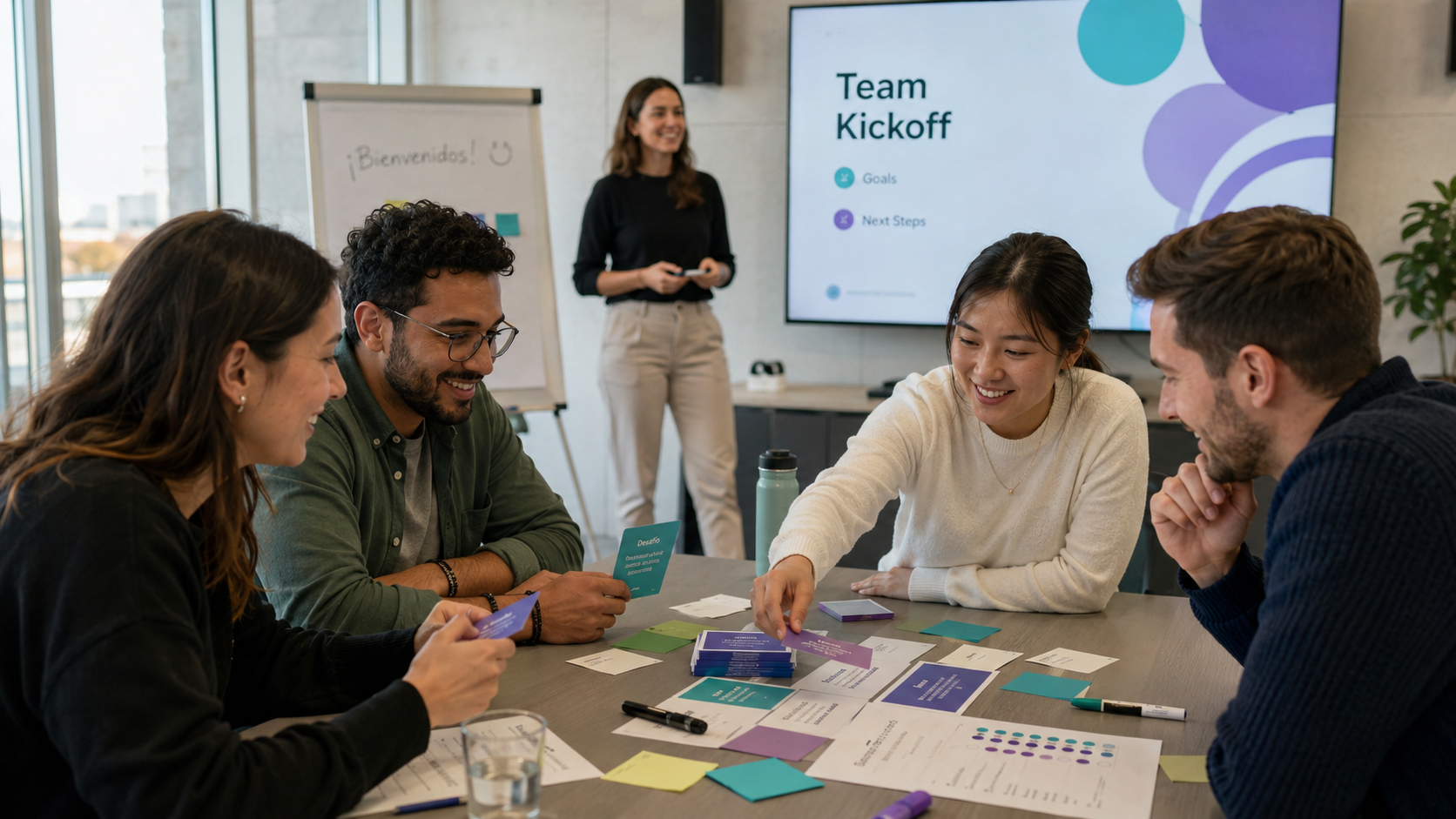
Ideas for gamifying a team kickoff
A kickoff marks the beginning of a new phase: a year, a quarter, a project or a strategy. It is usually the moment when an organisation shares objectives, priorities and expectations, but it can also become a sequence of presentations with little room for participation.
Gamification can help the team do more than listen. When it is designed well, it allows people to interpret the strategy, practise decisions, connect with colleagues and turn general messages into concrete actions.
The aim should not be to add a game for its own sake. The activity needs to reinforce what the kickoff is intended to achieve.
Before choosing an activity
Start by answering four questions:
- What do we want participants to understand, practise or decide?
- Do the people involved already know and work with one another?
- How much time can we genuinely allocate to the activity?
- Do we need to collect results, opinions or commitments for later follow-up?
These answers will make it easier to choose an experience that fits the event.
1. Predictions for the new period
Before presenting all the data, ask participants to make predictions about the coming quarter or year.
For example:
- Which trend will have the greatest impact on the business?
- Which product will grow the most?
- What will be the team’s main challenge?
- Which customer behaviour will change first?
The responses can be displayed live and later compared with the leadership team’s perspective. The activity reveals expectations, prior knowledge and possible differences in perception.
The purpose is not to predict the future correctly. It is to begin a conversation about the factors the team considers important.
2. A mission to discover the strategy
Instead of presenting the entire strategy on one slide, divide it into a series of clues, decisions or challenges.
Each group receives part of the information and must reconstruct:
- The main priorities.
- The key audiences.
- The most significant risks.
- The actions likely to have the greatest impact.
The teams then compare their proposal with the actual strategy. This mechanic requires them to interpret the information and understand the relationship between objectives, decisions and results.
3. A priorities escape room
A corporate escape room can be used to explore the priorities for the new period, provided that the challenges are connected to the content of the kickoff.
Tasks might include:
- Ordering initiatives according to their likely impact.
- Identifying a risk in a practical case.
- Finding relevant information among several data points.
- Resolving a customer situation.
- Connecting company values with specific decisions.
The narrative creates tension and momentum, but it should not overshadow the message. If the puzzles could be used unchanged at any company, the experience is probably not sufficiently personalised.
4. Decision-making scenarios
An effective way to work with strategy is to present situations the team may face in the months ahead.
Each group decides how it would respond to issues such as:
- An unexpected change in priorities.
- An urgent customer request.
- A conflict between quality, time and budget.
- An opportunity requiring several departments to coordinate.
After every choice, the possible consequences are shown. There does not have to be one correct answer. The important point is to make the decision criteria visible and connect the discussion with the organisation’s principles.
5. A team connections map
When a kickoff brings together people from different areas, a connection activity can help reveal who knows what, who is working on which issues and where opportunities for collaboration exist.
Missions might ask participants to:
- Find someone who works with a different type of customer.
- Identify a person who could help solve a particular challenge.
- Discover a skill within the team that is not widely known.
- Identify two departments that should work together more closely.
The activity should enable useful conversations rather than force people to exchange contact details without context.
6. A decision quiz, not just a memory test
Quizzes work well for activating large groups, but they are more valuable when they go beyond figures and definitions.
Instead of asking participants to recall an objective, present a situation and ask which action would make the strongest contribution to achieving it.
A useful kickoff quiz may include:
- Short cases.
- Prioritisation exercises.
- Error detection.
- A choice between different responses to a customer.
- Questions about how to apply a company value.
The feedback following each response is just as important as the score.
7. A company values challenge
Values are often presented as broad words. An activity can translate them into observable behaviours.
Each team receives real or fictional situations and decides:
- Which value is involved.
- Which behaviour would be consistent with that value.
- Which decision might contradict it.
- How the team would act in practice.
Participants can also provide real examples of moments when the organisation demonstrated those values. This helps prevent the exercise from remaining at the level of abstract statements.
8. Collaborative roadmap building
Participants can work with an incomplete roadmap and decide which milestones, dependencies or risks should be added.
Each group can represent a different area and contribute its own perspective. The proposals are then combined into a shared view.
This activity is particularly useful when the kickoff is not simply communicating a finished strategy, but also collecting input from the people responsible for delivering it.
For the process to be credible, everyone must understand which decisions remain open and which have already been made. Pretending to consult people when they have no real ability to influence the outcome can create frustration.
9. Peer recognition
A kickoff can also recognise achievements and lessons from the previous period.
Instead of giving generic awards, ask participants to identify:
- A collaboration that produced a meaningful result.
- A person who made other people’s work easier.
- A difficult decision that was handled well.
- A lesson the team should preserve.
Recognition can take the form of messages, symbolic badges or short stories. Avoid categories that embarrass people, expose them unnecessarily or turn popularity into the main criterion.
10. Turn the final commitment into a mission
The kickoff can end with a specific action for the following weeks.
Each person or team defines:
- A behaviour they will begin to apply.
- An action they will stop doing.
- A collaboration they will initiate.
- An indicator they will review.
These commitments can become follow-up missions and be revisited later. The activity will only have value if there is a mechanism for returning to what was agreed after the event.
How to choose the right idea
Not every proposal will suit every kickoff. As a general guide:
- To activate a large audience: predictions, polls and decision quizzes.
- To improve understanding of the strategy: discovery missions and scenarios.
- To improve collaboration: connection maps and team challenges.
- To explore values: practical cases and peer recognition.
- To collect input: collaborative roadmap building.
- To support later application: commitments turned into missions.
Time also matters. A ten-minute intervention should focus on one simple action. A one-hour experience can include a narrative, several stages and a final reflection.
A possible kickoff structure
A balanced combination might be:
- Before the event: a prediction or short question to understand expectations.
- At the beginning: a quick activity to activate the audience.
- During the strategy presentation: decisions, polls or cases.
- After the main content: a collaborative challenge.
- At the end: a specific commitment and a method of follow-up.
It is not necessary to gamify every minute. Alternating listening, participation and reflection is usually more coherent than maintaining constant competition.
Common mistakes
Turning everything into a leaderboard
Competition can increase energy, but it can also distract from the objective or create unnecessary pressure. A collective challenge, or a combination of internal collaboration and competition between teams, may work better.
Rewarding speed alone
Answering first does not always mean understanding better. When the activity deals with decisions, values or strategy, the quality of the reasoning should also matter.
Using an activity that is too generic
The experience should include challenges, language and situations that the team recognises. Visual customisation is not enough when the content is unrelated to their reality.
Leaving no time for the conclusion
An activity without a final reflection can be entertaining but produce little learning. Explain what was observed and how it connects with the work that follows.
Failing to test the experience
Before the kickoff, review the timing, instructions, devices, connection and possible blocking points. A small pilot group will often identify problems that are not visible on paper.
How to measure the result
Depending on the objective, you can examine:
- Participation and completion rates.
- The most frequent responses and decisions.
- The points where teams required help.
- Connections created between different areas.
- Understanding of the priorities.
- Commitments made.
- Actions completed after the event.
Positive feedback about the activity is useful, but it does not prove that the kickoff changed behaviour. Some later follow-up will be needed to assess real application.
A participatory kickoff with a purpose
Gamifying a kickoff does not mean filling the agenda with points, prizes and leaderboards. It means designing moments in which people can interpret the strategy, make decisions, collaborate and understand what is expected of them.
The best activity will fit the objective of the event, respect the context of the team and produce a useful conclusion.
At Evenely, we design gamified experiences for kickoffs, corporate events, training, internal communication and recruitment. They can be created through a visual editor or developed as bespoke projects according to each organisation’s needs.