
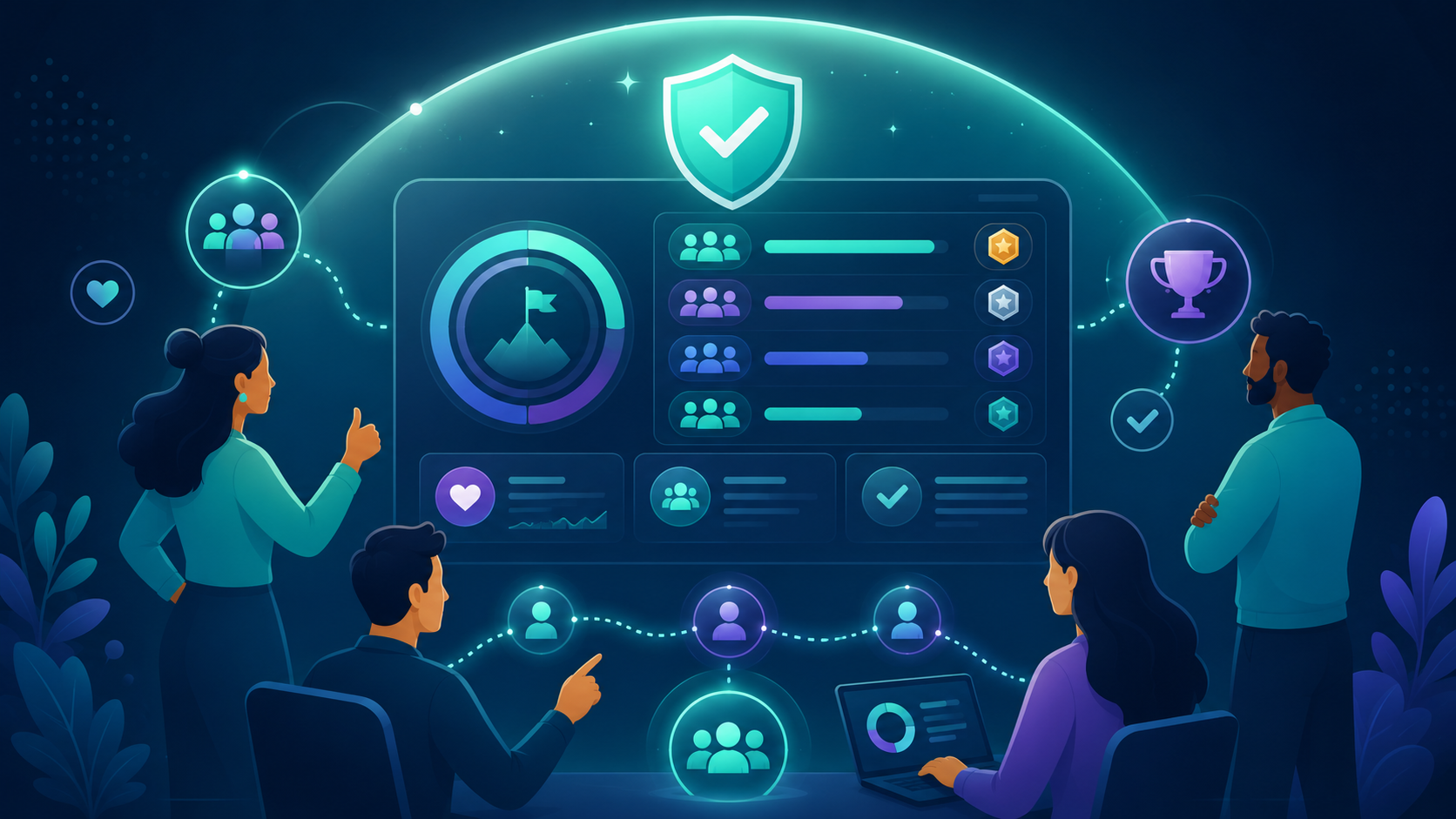
Competition can bring energy, focus and a clear sense of progress to a corporate activity. When it is designed without care, however, it can also make people feel watched, compared or penalised in front of the group. The answer is not to remove every competitive element, but to design competition so that it activates participation without undermining psychological safety.
Key idea
Healthy competition places people against a shared challenge. Unsafe competition places them against one another and turns every mistake into public exposure.
Competition is not the problem: visibility is
Two activities can use points and leaderboards while producing completely different experiences. In one, participants experiment, laugh about mistakes and collaborate to improve. In the other, a small number of people dominate the table while everyone else stops participating to avoid embarrassment.
The difference usually lies in the design of exposure: who appears on screen, what is rewarded, how long the comparison remains visible, what happens when someone fails and whether people can participate without taking an excessive social risk.
What psychological safety means in a gamified activity
Psychological safety does not mean that everything must be easy, that nobody can lose or that there can be no tension. It means that people can contribute, ask a question, suggest an answer or acknowledge a mistake without fearing ridicule, labelling or negative consequences.
At events, in training and in internal campaigns, this safety is communicated through small design choices:
- The rules are understood before the activity begins.
- Participants know which data will be visible.
- Mistakes are used for learning, not for singling people out.
- Difficulty does not rely on knowledge that was never explained.
- There is more than one way to contribute to the team.
- Speed only matters when it is genuinely part of the objective.
Eight design decisions for competition without exposure
1. Make the challenge the main opponent
Instead of asking “who knows the most?”, ask “can we solve this before the mission ends?”. Pressure is directed towards the problem rather than a particular person. A collective goal, shared score or story with a common threat preserves competitive energy without dividing the group.
2. Prefer teams to individual leaderboards
Teams reduce exposure and make it possible to distribute roles: analysing, deciding, finding clues, communicating or managing time. The challenge must require different contributions. When one person can answer everything, the team format merely conceals an individual competition.
3. Control what the leaderboard reveals
Names, exact scores and positions do not need to remain visible throughout the activity. Use aliases, avatars, progress bands or partial standings. You can also show the progress of leading teams without publicly ordering everyone else.
4. Reward more than one way of succeeding
When the only recognition goes to whoever finishes first, the same profile is repeatedly favoured. Recognise improvement, collaboration, reasoning quality, creativity or the ability to help another team. This broadens the definition of success.
5. Turn mistakes into useful information
An incorrect answer should not trigger a disproportionate penalty or block the participant. Feedback can provide a clue, explain the criterion or allow another attempt. When mistakes are part of the journey, people are more willing to experiment.
6. Use time for a clear reason
Timers create tension, but they can also penalise reading, accessibility and reflection. When the goal is to practise a complex decision, quality should matter more than speed. Time can be a generous limit or a narrative device without affecting the score.
7. Offer different levels of participation
Not everyone is comfortable speaking publicly or deciding on behalf of the group. Allow responses from personal devices, paired discussion, anonymous voting or different team roles. Participation should not always require exposure.
8. Explain the rules, data and purpose
Before starting, clarify what will be measured, who will see the result and how it will be used. In training or an internal campaign, a leaderboard should not unexpectedly become a performance assessment. Transparency reduces anxiety and prevents misunderstandings.
Warning signs that competition is leaving people out
- Participation drops when the leaderboard appears.
- The same person always answers for each team.
- Teams that start badly stop trying to recover.
- Correct answers are celebrated while mistakes are mocked.
- Speed outweighs the learning objective.
- Participants ask whether managers will receive their results.
- Some people try to disappear from the standings.
These signs do not mean competition must be removed. They show that visibility, scoring, team structure or facilitation needs to change.
The facilitator’s role
A tool cannot create a safe climate by itself. The person introducing the activity should normalise uncertainty, avoid comments about who is last and remind everyone that the standings are a partial snapshot of the game, not a measure of participants’ value.
They should also explain that collaboration is expected, step in when one person monopolises decisions and close with reflection. A debrief turns competition into learning: which strategies worked, how decisions were made and what the team would do differently.
What to measure besides who wins
A competitive activity provides more information than its final ranking. To assess whether the design was healthy, examine:
- The percentage of people who participate until the end.
- How contributions are distributed within teams.
- Improvement between the first and final attempt.
- The use of clues and second chances.
- Perceptions of comfort and fairness.
- The quality of decisions, not only their speed.
Checklist before publishing a competitive activity
Is the objective clear? Is visibility necessary? Can teams recover? Are there several ways to contribute? Do mistakes receive feedback? Is time relevant? Is the activity accessible? Do participants know how results will be used?
Compete to activate, not to label
Competition can be powerful when it creates curiosity, pace and a shared objective. It stops being useful when the ranking becomes a label, repeatedly rewards the same profile or makes participation feel too risky.
The best design is not the one that creates the most tension. It is the one that encourages more people to keep playing, learning and contributing even when they do not yet have the correct answer.
Design competition around the objective and the people
With Evenely, you can combine teams, configurable leaderboards, feedback, narrative and analytics to build competitive activities that increase participation without leaving anyone exposed.