
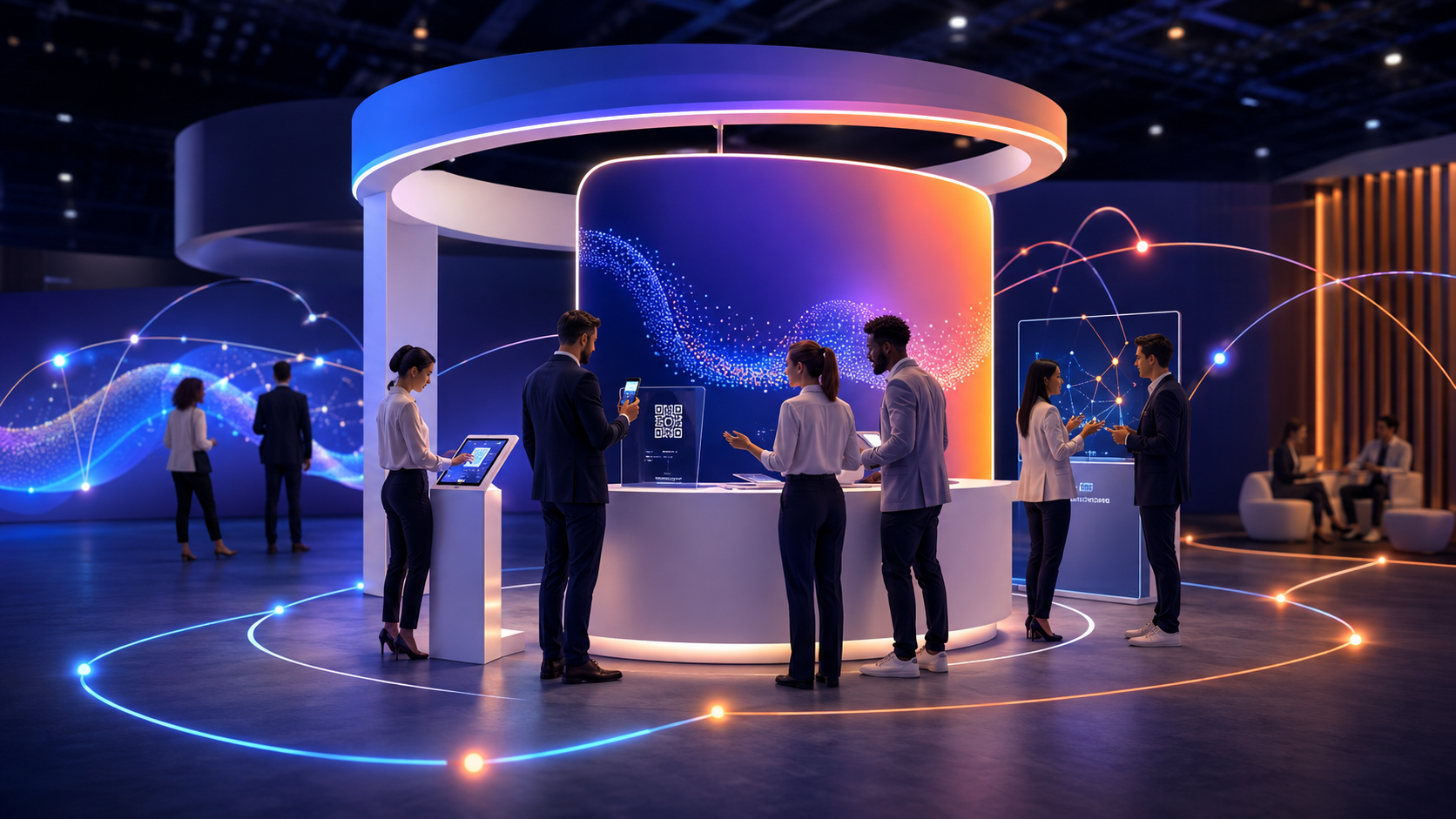
At a trade show or conference, attracting attention is relatively easy. The real challenge is turning that attention into useful conversations, relevant demonstrations and contacts with an identifiable need.
From traffic to opportunity
The best activity is not the one that creates the longest queue. It helps visitors recognise a relevant problem and gives the booth team a meaningful next conversation.
A queue is not a strategy
A high-quality visit is not defined only by participation. It happens when a visitor fits a relevant profile, recognises a need, understands a specific benefit, requests information or agrees to follow-up around a clear interest.
A visible promise that is easy to understand.
Questions that reveal profile, need or interest.
A result that gives the booth team useful context.
A later action connected to what was discovered.
Eleven decisions for a useful experience
1. Define who you want to attract
Specify sector, role, decision-making authority, problem, prior knowledge and buying stage. A clear profile supports recognisable questions and cases.
2. Connect the challenge to the value proposition
The activity should help people discover, practise or experience a real part of the solution. If it could be used unchanged at any booth, it is too generic.
3. Reduce friction at the start
Use a visible QR code, one-sentence instructions and no mandatory download. Consider collecting details after the first challenge, when the visitor understands the value exchange.
4. Choose a mechanic that opens conversation
The result should create a natural next question. Diagnostics, scenarios, discovery and recommendations work better than an activity disconnected from the product.
5. Design a short, complete sequence
Attraction, access, challenge, result, conversation and next action. Two to five minutes may be enough when every step has a clear purpose.
6. Integrate the booth team
Prepare what each result means, what question to ask next, when to offer a demonstration and how to record notes without duplicating work.
7. Collect only necessary data
Identity, company, role, interest, result and follow-up request may be enough. Do not turn every click into an assumed commercial signal.
8. Use rewards that support the objective
An extended diagnostic, demonstration, consultation or specialist resource usually attracts more relevant visitors than an unrelated incentive.
9. Plan for queues, failures and accessibility
Test duration, concurrency, devices, venue coverage and a technical fallback. Instructions should be readable and key information must not rely only on sound or colour.
10. Activate before, during and after
Before the event, use a short challenge to arrange visits; during it, adapt the journey; afterwards, send content related to the need or recommendation discovered.
11. Measure quality, not only volume
Compare participation with relevant profiles, conversations, demonstrations, meetings, follow-up permissions and later commercial opportunities.
Six mechanics that suit a booth
Creates a profile or recommendation that starts a personalised conversation.
Reveals functions and benefits through small decisions.
Supports discussion of criteria, risks and real needs.
Connects stations and demonstrations without making the journey unnecessarily long.
Creates visible activity through a shared objective.
Leads to the most relevant product or case based on responses.
Example of a complete experience
Visible question: “What is reducing participation in your training?”
- The visitor answers four short situations.
- They receive a profile: too much content, too little practice, low motivation or no follow-up.
- The team asks about context and shows a related demonstration.
- Follow-up includes a guide tailored to the identified problem.
Metrics that add value
- Participation and completion.
- Visitors who match the target audience.
- Conversations started from the result.
- Demonstrations, meetings and requests.
- Needs and topics identified.
- Accepted follow-ups and later responses.
- Commercial opportunities generated.
An interaction with continuity
Evenely connects the challenge, result and analytics so the experience does not end when the visitor leaves the booth.