
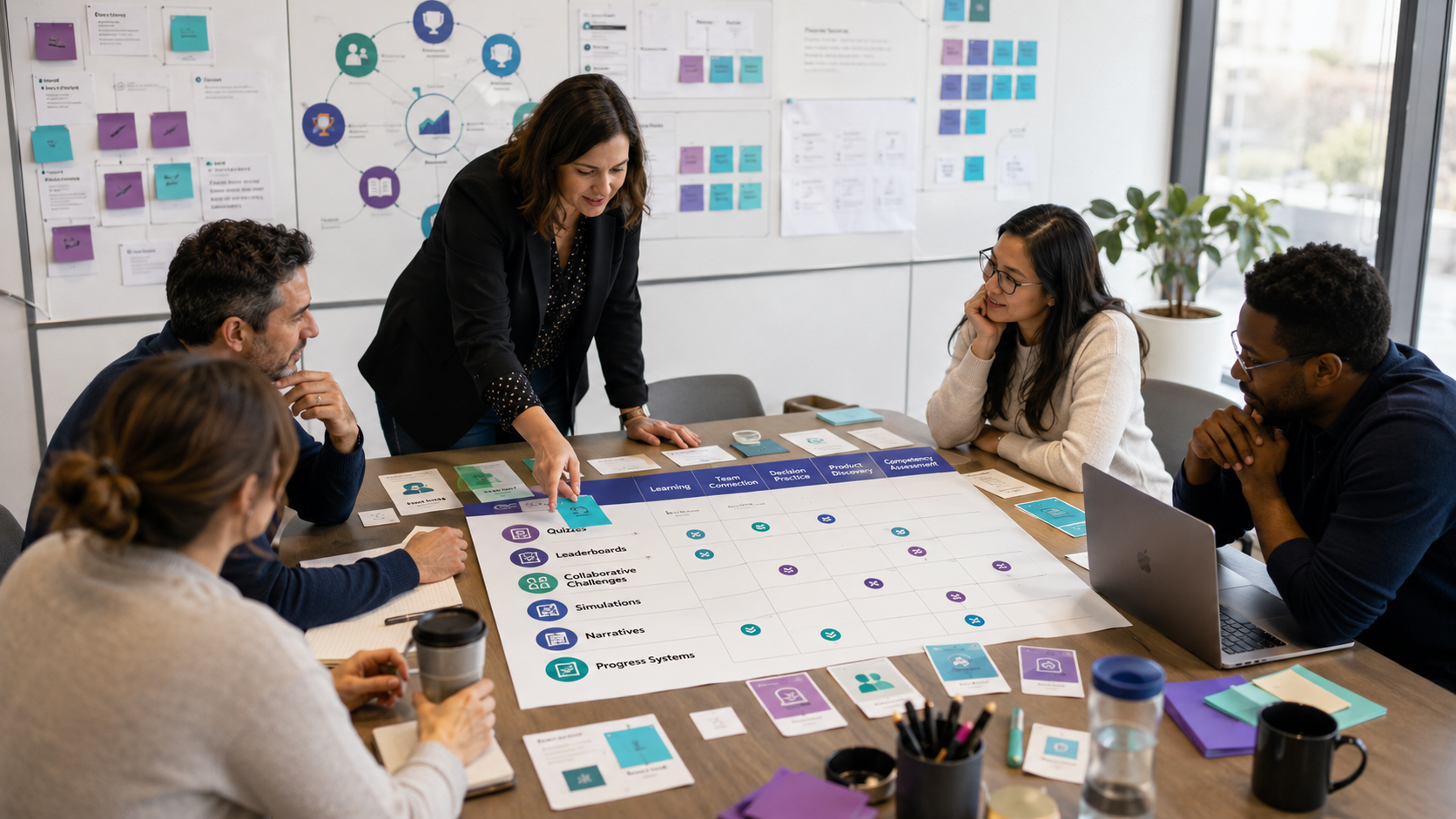
When a company decides to gamify training, an event or an internal campaign, it often begins with the format: quiz, leaderboard, escape room or simulation. The problem is that the mechanic describes how people participate, not the result the organisation needs.
Objective first, game second
The best mechanic is not the most spectacular. It is the one that makes the behaviour you want to activate, practise, observe or transform visible.
Translate the objective into observable behaviour
“Increase participation” is too broad. Define what people should do during or after the experience.
- Identify the three priorities for the new period.
- Practise responding to a sales objection.
- Start useful conversations between departments.
- Apply a professional criterion in a simulated situation.
- Discover why a product feature is relevant.
Eight objectives and the mechanics that fit them
01 · ATTENTION
Break passive observation
Use predictions, live polls, quick choices, observation and team voting. The first interaction should require little effort and produce a visible response.
Avoid: starting with complex rules or a competition that creates excessive exposure.
02 · LEARNING
Check understanding
Combine short cases, decisions, sequencing, error detection, consequences and spaced challenges. Feedback should explain the criterion rather than only show right or wrong.
Measure: response quality, improvement between attempts and application in a new case.
03 · PRACTICE
Rehearse decisions and behaviours
Simulations, branching, roles and progressive feedback allow people to practise conversations, incidents, priorities or leadership and see consequences.
Measure: decision quality and ability to transfer it to work.
04 · COLLABORATION
Build a shared response
Use missions with distributed information, interdependent puzzles, joint prioritisation, decision maps and collective goals.
Check: that one person cannot solve everything while everyone else watches.
05 · NETWORKING
Create a reason to talk
Use missions to find experience, affinity maps, event-related questions and challenges that need contributions from several people.
Avoid: rewarding only the number of contacts; value the relevance of connections.
06 · PRODUCT
Discover the value proposition
Diagnostics, customer cases, comparisons, exploration routes and decisions with consequences connect needs with solutions.
Objective: understand why a feature matters rather than memorise its name.
07 · PROGRESS
Recognise progress and sustain participation
Points represent progress, badges recognise milestones and levels organise a sequence when linked to valuable actions.
Avoid: rewarding irrelevant actions or allowing people to collect points without learning.
08 · ASSESSMENT
Observe professional competencies
Use work simulations, cases, prioritisation and situational judgement. Scores should be based on defined criteria rather than decorative speed.
Requires: transparency, accessibility, validity and human review.
What each resource contributes
Questions before deciding
- What behaviour do we want to create?
- What evidence will show that it happened?
- Should the activity be individual, collaborative or competitive?
- What level of exposure is appropriate?
- Is speed genuinely part of the objective?
- Which accessibility barriers could the mechanic create?
- What data do we need to collect?
- How will the result connect to a later action?
Design from purpose
Evenely combines questions, decisions, narrative, teams, progression and analytics. The right combination always begins by defining what should change when the experience ends.