
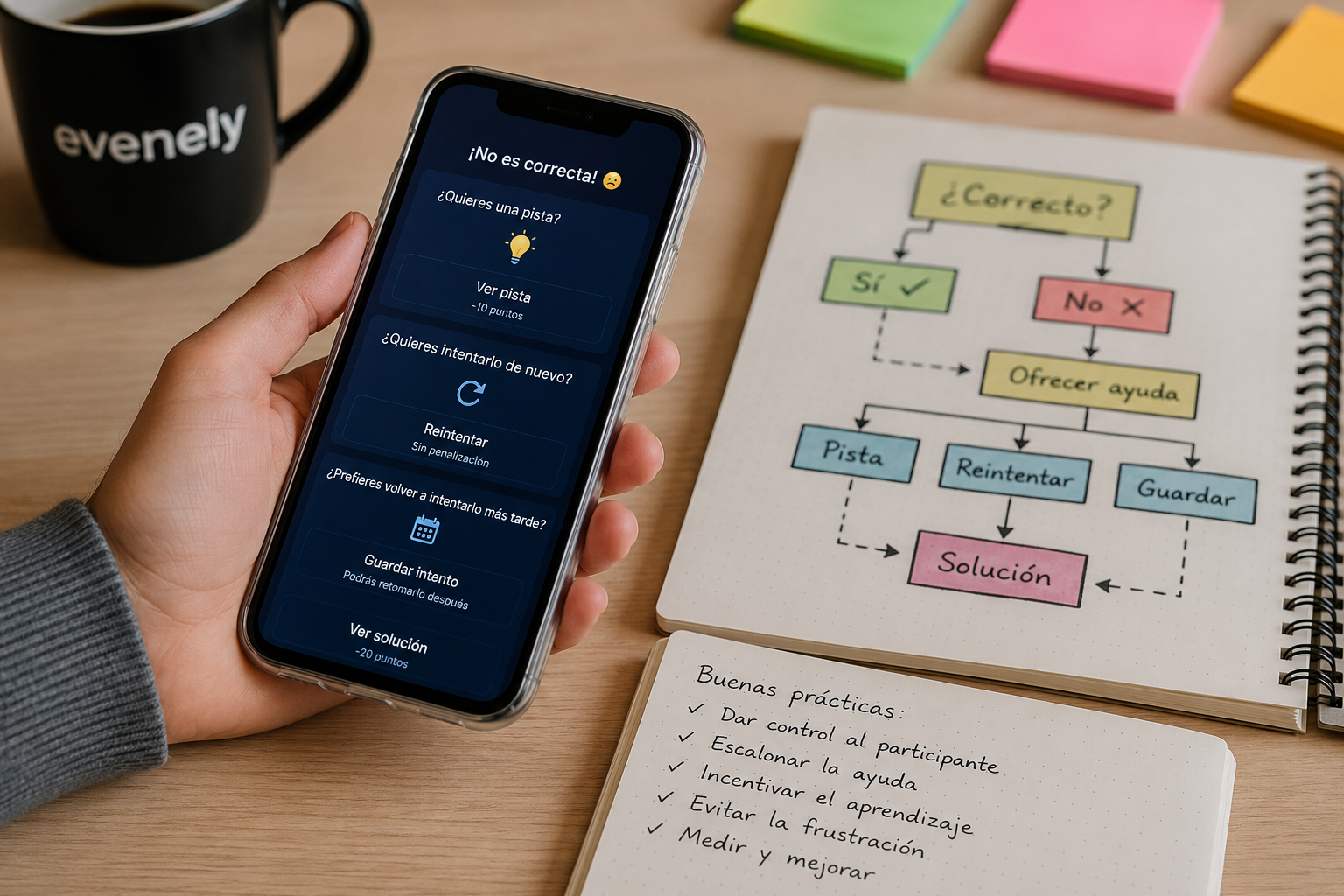
Immediate feedback helps people identify an error and adjust their reasoning before continuing. However, revealing the complete solution after the first attempt can turn a learning activity into a sequence of exposed answers.
Help without solving
Good feedback does more than deliver the correct answer. It directs attention to the criterion that helps people find it and apply it in another situation.
Feedback is not the same as a solution
“Incorrect answer” provides very little. Showing the right option allows progress, but does not require the learner to reconsider their reasoning. Useful guidance points to the need, evidence or consequence that deserves another look.
Example guidance
- Review the main need expressed by the customer.
- Check whether your answer solves the problem or only explains the procedure.
- Look for the option that acknowledges the situation before proposing an action.
The progressive feedback ladder
STEP 1 · Confirmation
Indicate that the response needs review without revealing the solution: “You are close, but one consequence is missing”.
STEP 2 · Hint
Direct attention to a specific element: a deadline, exception, relevant fact or impact on someone.
STEP 3 · Explanation
When uncertainty no longer adds value, show the recommended option and the criterion behind it.
STEP 4 · Transfer
Present a different case to check whether the learner can reuse the criterion rather than merely recall the answer.
Eleven decisions for better feedback
1. Define the learning objective
Clarify whether the challenge requires recall, understanding, risk detection, procedure application, comparison or justification.
2. Use progressive levels of help
Begin with brief confirmation, continue with a targeted hint and reserve the full explanation for the right moment.
3. Do not turn error into punishment
Describe the requirement, evidence or consequence that was missed. Avoid messages that embarrass or block the learner.
4. Explain why
Clarify why one option is appropriate, why alternatives are less suitable and how the criterion applies at work.
5. Allow another attempt
After a hint, let learners change their answer, review the case, consult content or compare alternatives.
6. Ask about confidence
A correct answer with low confidence may need explanation. An incorrect answer with high confidence signals a misconception.
7. Delay the solution when discussion adds value
Collect decisions, show their distribution anonymously, allow arguments and permit changes before the debrief.
8. Match feedback to the error
Forgetting content, missing a clue, applying a rule in the wrong context and choosing a partly correct option require different messages.
9. Avoid revealing future answers
Review the sequence so one explanation does not solve later challenges indirectly. Guide the principle without disclosing everything.
10. Separate feedback from scoring
Points show game performance but do not explain success or improvement. Combine outcome, score, guidance and next action.
11. Design feedback with the question
Write the challenge, alternatives, likely errors, hints, explanation and retry together. If an option is hard to explain, the question may be ambiguous.
A practical template
- Correct answer: confirmation, criterion and connection to practice.
- First error: brief guidance on what to review.
- Second error: a specific hint linked to evidence.
- Closure: recommended answer, explanation and consequences.
- Transfer: a new case requiring the same principle.
How to know whether feedback works
Track how many learners correct an answer after a hint, where more attempts are needed, which errors recur and whether the criterion is applied in later cases.
Feedback that teaches
At Evenely, feedback can adapt to each attempt, alternative and error type. The key is to provide help without removing the space to think, decide and transfer learning.